On January 14th, Oneup Components released their first clipless pedal; simply called “Clip Pedals.” At first glance it would be easy to mistake these pedals for SPD knockoffs that come in pretty anodized colors. However, there are key differences between Shimano and OneUp pedals. Below are the Clip Pedal’s unique features.
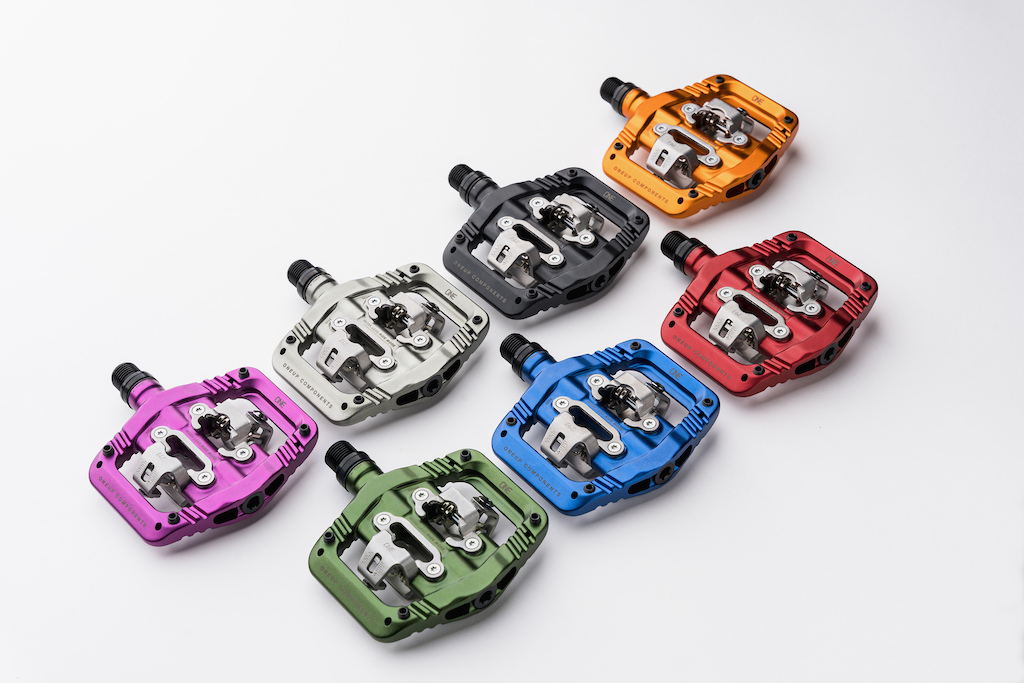
Platform Size, Weight and Price
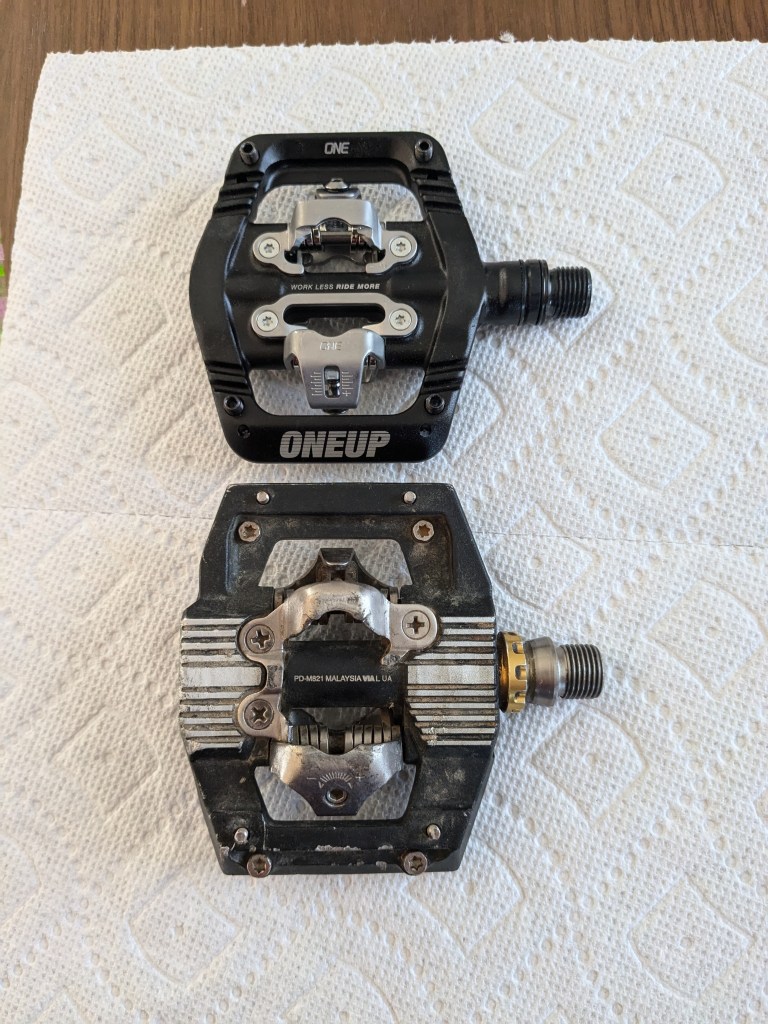
OneUp’s clip pedal’s platform size is roughly the same size as Shimano’s Saint pedals, but the pedal body is much thinner. OneUp claims that these are the thinnest clip pedals on the market, this should slightly reduce stack height and prevent rock strikes.
The OneUp pedals are much lighter than Saints; tipping the scales at just 410 grams, a whole 130 grams lighter than the Saints. The OneUp pedals are very close in weight to featherweight 400 gram XTR Enduro pedal, which is remarkable considering the OneUps platform is much larger.
The OneUps are priced competitively at $159.99; on par with the $160 Shimano Saints.
OneUp’s Party Trick: Tight Cleat Fit and Longer Pins
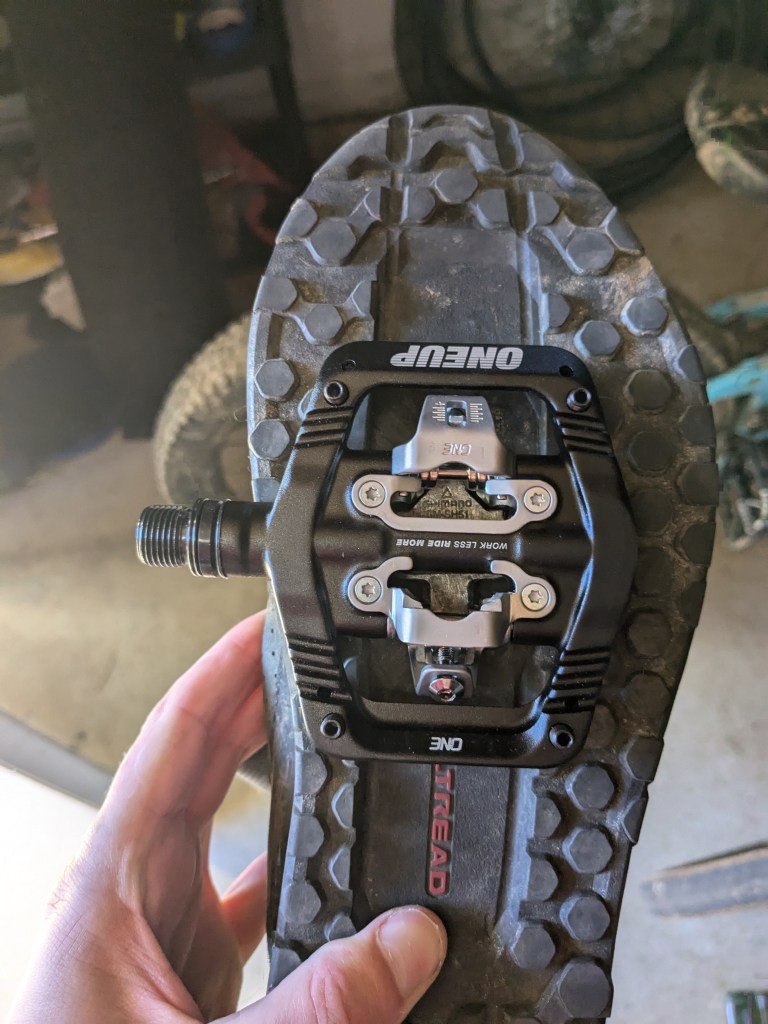
While OneUp’s Clip Pedal is much lighter than many Shimano offerings, their major difference is a tighter cleat fit. SPD pedals tend to have a bit of play between the binding and cleat; your shoe can rock up and down on the pedal ever so slightly. OneUp’s pedals have virtually no play in the system. In addition to this tighter cleat to binding interface, OneUp uses a spring with higher tension which results in a significantly higher release tension than SPD pedals. OneUp accomplishes this while retaining the same 5 degrees of float that SPD pedals have and a similar 12 degree release angle (SPD is 13 degrees) OneUp supplies their own SPD comptabitle cleats, but it should be noted that Clip Peda are compatible with Shimano SH-51 cleats.
The pins on OneUp’s pedals are much longer and thicker than the pins found on Saints. I ride with Shimano GE900 shoes and the pins on the Saint’s never contacted my shoes. After riding the Saint’s I can see some evidence of contact in the form of indentation on the soles of my shoes. Only the rear pins make contact, however. The pins unfortunately are not adjustable and are designed to bottom out in their threads. The pins can be removed from either end of the pedal, making it easy to replace damaged pins. OneUp includes cleat spacers to prevent release interference created by pin contact on thick soled shoes.
Serviceability
OneUp pedals are designed to be fully user serviceable. Not only can you replace the axle bearings and bushings you’re able to replace other small parts on the pedal as well. It appears only the bearing service kits are available on OneUps website right now. Perhaps later, other service parts will become available.
The rebuild procedure is a bit more involved than Shimano’s simple grease flush process and involves replacing cartridge bearings, bushings, an Igus bearing and seals. However, it doesn’t look difficult even for someone as mechanically inept as me.

Build Quality
The clip pedals look and feel premium. While Shimano pedals are prone to free spinning and bearing play, OneUp’s clip pedals have a tight bearing seal and have no play. We’ll see how they wear it though.
What’s In The Box?
For your hard earned $160 you get a pair of pedals, OneUp’s SPD compatible cleats, cleat spacers and a pedal bushing tool to help you with servicing your pedals. I think the inclusion of the tool is just nifty, as some Shimano pedals require a proprietary tool that you have to purchase separately.
Ride Impressions
Finally, let’s talk about how these pedals feel on the trail. I only have 4 rides on these pedals, but that’s enough to give me a sense of how they feel. In several month’s I’ll report back on their durability.
The Testing grounds

I rode these pedals somewhere on a variety of trails in Pisgah National Forest. I tried to include as much technical climbing as possible to test the pedals ease of release when I inevitably made a mistake. I also included some classic high-speed Pisgah chunk as well as some “locals-only” loamers. I felt this was a good representation of riding in Western North Carolina and mountain biking generally. Perhaps missing from the test loop were the technical rocky climbs you find in the deserts of the West and New England.
Pros:
Instant Familiarity
If you already use Shimano SPD pedals, then you’re going to feel at home on OneUp’s clip pedals. They’re compatible with SPD cleats, so if you’ve got a pair of shoes you can mount these to your cranks and go out for a ride with minimal set-up.
I installed the included OneUP cleats based on OneUp’ recommendation, however these can also be used with Shimano SH51 cleats. OneUp cannot confirm compatibility with multi-release cleats or other brands of SPD compatible cleats.
Tight Cleat Fit + Functional Pins = A More Stable Feeling Pedal
The platform of OneUp’s Clip Pedal provides plenty of stability, however it’s roughly the same size as Shimano’s Saint pedals. The real improvement in these pedals lies in its tighter cleat fit.
Recently I’ve been spending time riding flat pedals, and when I came back to SPD pedals. I noticed how much play was in the binding. On rough trails I could feel the cleat rattling against the binding mechanism. The float had a “skating on ice feel” as my foot freely rotated on the pedal. It was unnerving after spending time on flat pedals with tall pins that allow for no lateral movement.
The OneUp pedals feature a significantly tighter cleat fit than SPD pedals and feel LOCKED-IN. There’s no play in the pedal and the float feels more natural. Perhaps it’s a function of the sole and pedal pin interface, but OneUp’s Clip Pedals feel like they have less float. I tried to take notice of this. When I found myself spinning up a fire road climb I could feel the pedal float, but when I weighted the pedals while descending I felt very little movement. All I can surmise is that when weighted the pedal pins dug into the soles of my shoes and prevented them from moving. This provided a very confidence inspiring feel on steep and rough descents.
These pedals have damn near the stability of a flat pedals with the added security of clipless pedals.
Cons:
High Release Tension and a tighter cleat fit
What makes these pedals so good is may also be a negative. The higher release tension means it can be harder to clip-in and out of these pedals.
Many riders found SPD pedals to not offer enough release tension, leading to accidental releases. Personally, I was always able to find a setting that suited me within SPDs range of adjustability.
OneUP’s pedals ship with 3 clicks of spring tension, which in my opinion is very tight and they’ll go even tighter. After some experimentation I found that I prefer these pedals on their lowest setting. The lowest setting on OneUp’s pedals is about 3-4 clicks of increased tension on an SPD pedal.
As a result of increased spring tension it can be slightly harder to find the entry point of the binding mechanism and you have to be more deliberate while unclipping. The entry/release action iisn’t as smooth as Shimano, but I purposely rode some awkward trails that required me to unclip unexpectedly and I was able to get out of the pedal seamlessly each time.
An early review of these pedals on nsmb.com (https://nsmb.com/articles/oneup-clip-pedal/) gave me some pause when purchasing these pedals. The author stated that sometimes his left pedal would not release leading to some slow speed falls. He went through the effort of testing different cleats and found that this only happened with OneUP’s cleats and Shimano’s cleats did not have any issue unclipping.
I never experienced being unable to release my cleat from the pedals, but at the higher tension settings I did feel a bit of a hang. You could hear the spring mechanism release, but when I tried to take my foot off the pedal it felt like the cleat was getting caught on the pedal somewhere. When I reduced the tension of the pedals, this has gone away, but as stated above the release is still not as smooth as Shimano’s. This, so far as not resulted in me crashing, even in scenarios that required me to abruptly unclip. If this continues to be a problem, I’ll change to Shimano cleats and report back. I don’t see this as being an issue, but it’s worth mentioning because others have mentioned a similar issue in reviews.
Anodization Scuffs Easily
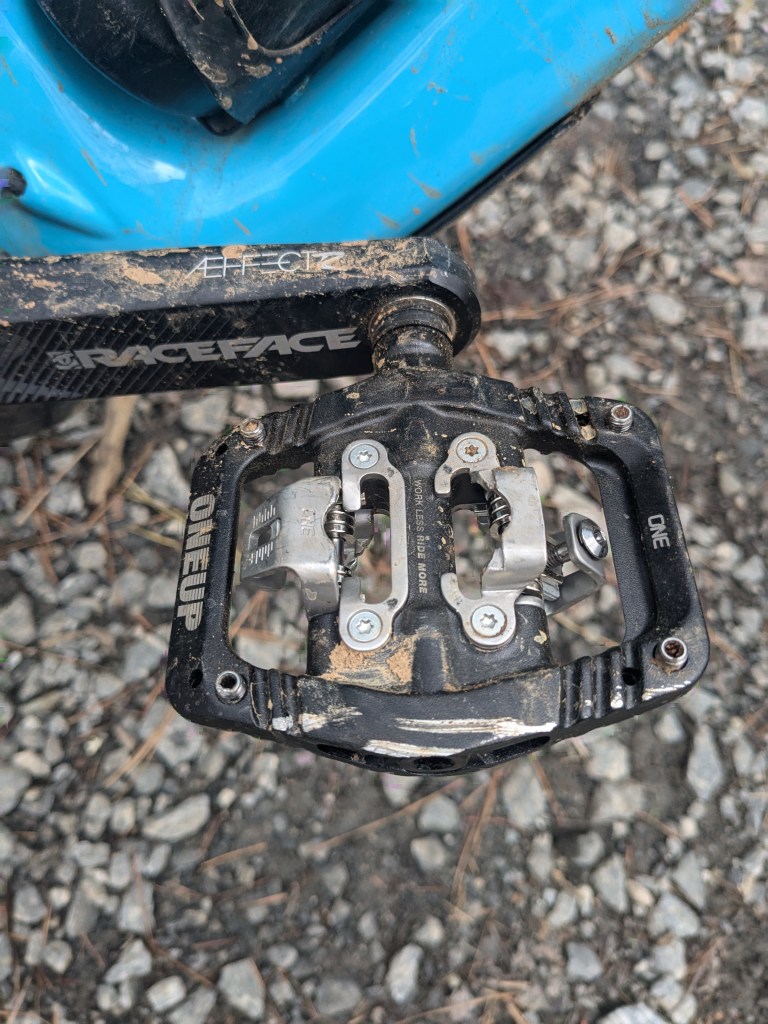
This really does’t bother me, but if you bought these pedals in pretty colors it might. Despite having a thinner pedal body, rock strikes are inevitable. After a few rock strikes the ano on my pedal has worn away exposing bare aluminum. I think these pedals will look quite rough after some time, but if they remain functional, I will be happy.
Overall Review
Time will tell how durable these pedals are, but overall, some subtle design tweaks in the SPD system have resulted in a pedal that feels much more stable and secure than Shimano SPD pedals. While the entry and engagement of the pedal may not be as smooth as Shimano, the trade-off of a solid feeling pedal is well worth it. Though these pedals are aimed more towards gravity riding, their low weight and reasonable price point should attract a variety of riders. aI really enjoy riding these pedals and if they prove to be as durable as Shimano Pedals, they may become my favorite clipless, coughs, ahem, clip pedal.
 The Descent
Leave a comment